

InfuseOS vs Dify: How AI Is Changing Workflow Automation
Discover how InfuseOS and Dify differ and what their approaches reveal about the future of AI-powered workflow automation.


InfuseOS and Dify are both part of the new AI automation landscape, but they approach workflow automation from different angles. InfuseOS is oriented toward connected workplace execution, while Dify is oriented toward building and orchestrating AI applications. Comparing them side by side helps clarify where each platform fits.
AI is changing how organizations think about work. Instead of relying only on fixed rules, businesses now want systems that can interpret context, support decisions, generate content and trigger actions across multiple tools. That shift is redefining what companies expect from modern workflow automation tools.
InfuseOS and Dify are often discussed in that broader conversation because both use AI to improve how work gets done. However, they are not identical products, and they are not designed for the exact same user journey. One is more focused on operational assistance across workplace tasks. The other is more focused on creating and managing AI-powered applications and workflows.
This article explains what each platform does, where they differ and how both reflect the wider evolution of AI-driven automation.
How AI is Changing Workflow Automation
The comparison between InfuseOS and Dify also highlights a larger market shift. AI is expanding workflow automation beyond fixed rules and simple triggers.
Traditional automation was effective for repetitive, structured tasks. AI adds the ability to interpret language, summarize content, classify intent, generate responses and support more adaptive decision-making. That changes what businesses can automate and how they think about value.
Here are four ways AI is reshaping automation.
AI adds context to workflows
Older automations were good at moving information. AI can help interpret that information.
For example, a workflow can now:
- Read an incoming message
- identify the request
- draft a response
- route the issue
- trigger follow-up actions based on context
This makes automation more useful in real business situations where inputs are not always structured.
AI expands automation into knowledge work
Many business processes involve judgment, communication and summarization. AI can now assist with those tasks, which means automation is no longer limited to back-end rule chains.
That is why newer workflow automation tools are increasingly being evaluated not just on integrations, but also on how well they handle context and decision support.
AI changes the user experience
The old model of automation often required people to adapt to software. AI is pushing software to adapt more naturally to people through language, memory and context-aware assistance.
That shift is helping create systems that feel less like static dashboards and more like dynamic workplace layers.
AI raises expectations for usability
As AI becomes more capable, users expect more than intelligence alone. They also expect visibility, trust, control and a manageable experience. That is true whether the platform is aimed at workplace users or technical builders.
This is one reason the market is now split across several categories, including:
- End-user assistants
- AI app builders
- orchestration platforms
- enterprise productivity software
- operational workflow systems
InfuseOS and Dify sit in different parts of that evolving landscape.
What is InfuseOS?
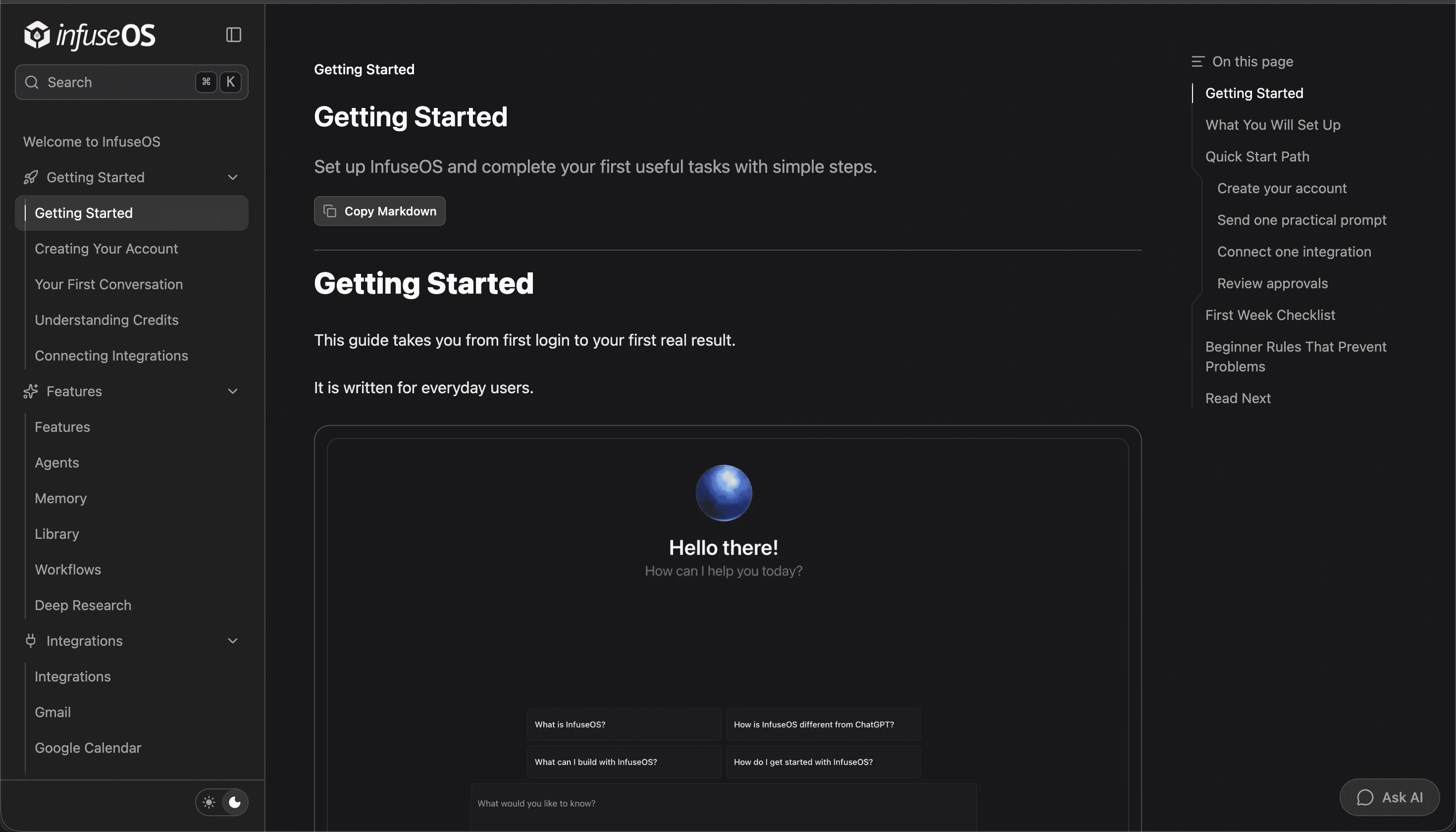
InfuseOS is an AI workflow platform designed to help users manage and complete work across connected business tools. It is positioned around practical workplace execution, with an emphasis on usability, visibility and task completion.
In simple terms, InfuseOS aims to function as an AI workplace assistant that can support business operations across different apps and workflows. Rather than centering the experience on technical setup, it focuses on helping users interact with AI in a more direct, operational way.
Common themes associated with InfuseOS include:
- Cross-tool workflow support
- User-facing automation
- Assisted and autonomous operating modes
- Workflow visibility and management
- Memory and context control
- Simpler adoption for general business use
This makes InfuseOS relevant for teams that want AI embedded into everyday work processes.
What is Dify?
Dify is an open-source platform for building, testing and deploying LLM-powered applications. It is designed for teams that want to create AI assistants, retrieval systems, multi-step workflows and custom AI experiences with more technical control.
Rather than serving primarily as a workplace execution layer, Dify is often used as a development environment for AI systems. It gives teams tools to manage prompts, models, orchestration logic and application behavior.
Typical Dify use cases include:
- Building internal AI assistants
- Creating retrieval-augmented applications
- Managing prompts and workflows
- Designing custom AI interactions
- Deploying self-hosted or configurable AI systems
That makes Dify especially relevant for organizations that want to shape the AI layer more directly.
InfuseOS vs. Dify: Key Differences
1. Primary audience
InfuseOS appears more aligned with business users and teams looking for AI-assisted execution across day-to-day work. Its value is easier to understand in environments where users want automation without a heavy build process.
Dify appears more aligned with developers, technical operators and product teams that want to construct AI systems with greater control over prompts, logic and deployment.
This distinction affects adoption:
- Business-led teams may gravitate toward platforms that simplify action and usability
- Technical teams may prefer platforms that expose more configuration and development depth
2. Product philosophy
InfuseOS is generally framed around using AI to help complete work inside connected business environments. The emphasis is on practical operations and a more direct user experience.
Dify is generally framed around giving teams a toolkit to create AI applications. The emphasis is on flexibility, orchestration and system design.
Both philosophies are valid. They simply address different layers of the AI workflow stack.
3. Setup and complexity
InfuseOS is typically associated with a simpler path to adoption, especially for users who do not want to build agents or design workflows from scratch.
Dify typically offers more room for customization, but that can also mean a more technical setup depending on the use case.
A useful way to think about this tradeoff is:
- Simplicity can support faster business adoption
- Flexibility can support deeper technical customization
Organizations often have to decide which of those matters more in the near term.
4. Workflow execution vs workflow construction
InfuseOS is more closely associated with operational workflow execution. That includes scenarios where AI is expected to support tasks across communication, coordination and recurring processes.
Dify is more closely associated with workflow construction. It is often used to define how AI systems should respond, retrieve information and move through a sequence of logic steps.
This difference is subtle but important. One platform is more focused on AI in use, while the other is more focused on AI by design.
5. Transparency and control
Transparency is becoming a core issue in AI adoption. Businesses want to understand what the system is doing, what context it is using and how automations can be managed.
InfuseOS emphasizes user-level visibility into workflows and memory. That can be valuable for teams that want operational clarity.
Dify emphasizes configuration-level control over prompts, logic and model behavior. That can be valuable for teams that want technical oversight and architecture flexibility.
In practice, both offer forms of control, but they express that control differently.
6. Role in the broader software stack
InfuseOS fits more naturally into conversations about connected workplace operations and user-facing productivity software.
Dify fits more naturally into conversations about AI infrastructure, LLM application layers and developer-centric orchestration.
That distinction matters because many companies are not just buying tools. They are deciding where AI should sit inside their overall operating model.
When InfuseOS May be a Better Fit
InfuseOS may be a stronger option for organizations that want:
- AI support embedded into daily workplace tasks
- Easier adoption across non-technical teams
- Cross-tool workflow assistance
- More direct operational visibility
- A platform experience centered on execution
This can be relevant in environments where speed of adoption and practical usability are key decision factors.
When Dify May be a Better Fit
Dify may be a stronger option for organizations that want:
- Greater control over AI app design
- Open-source flexibility
- Custom prompt and workflow orchestration
- Developer-led implementation
- More ownership over deployment and architecture choices
This can be relevant in environments where technical customization and internal AI development are central requirements.
Which is Right For You?
For most organizations, the right choice depends on three questions:
- Who will use the platform most often? If the primary users are business teams, a workplace-oriented experience may matter more. If the primary users are developers or product teams, builder-oriented flexibility may matter more.
- Do you want to use AI directly or build AI systems internally? Some organizations prioritize immediate operational gains. Others prioritize long-term AI infrastructure and custom application development.
- What kind of control matters most? Some teams want visibility into tasks, workflows and memory. Others want control over prompts, models, logic and deployment.
If your organization wants an AI workplace assistant that can support connected work in a user-facing way, InfuseOS may align better.
If your organization wants a platform for building and managing custom AI applications, Dify may align better.
In many cases, the decision is less about superiority and more about fit.
Final Thoughts
InfuseOS and Dify are both examples of how AI is transforming workflow automation, but they represent different approaches to that transformation.
InfuseOS reflects the move toward AI systems that support workplace execution more directly. Dify reflects the move toward modular platforms that let teams create and manage their own AI applications.
Both directions are important. Both respond to real business needs. And both show that the future of automation is becoming more contextual, more flexible and more closely tied to how organizations actually work.
The best choice depends on your team structure, technical capacity and automation goals. For some companies, the priority will be usability and operational flow. For others, it will be customization and architecture control.
As AI adoption grows, that distinction will become increasingly important.