

InfuseOS vs GenFuse AI: Which Platform Offers More Practical Business Value?
Compare InfuseOS vs GenFuse AI to see which platform delivers more practical business value through automation, execution, integrations and context.


AI adoption is moving into a more practical phase. For most companies, the question is no longer whether to use AI. It is whether a platform can improve execution, reduce operational friction and create measurable business outcomes.
That shift makes comparisons like InfuseOS vs GenFuse AI more relevant. Both sit within the growing category of AI tools for business, but they are built around different ideas of value. One is centered on helping teams get work done across systems. The other is centered on helping users structure, automate and accelerate specific tasks. To put it simply, this comparison is really about execution vs assistance.
Why this comparison matters now
Many organizations already have AI features inside the tools they use every day. What they often lack is a system that connects those capabilities to actual outcomes. That is where platform choice matters.
The main difference is not whether a platform can generate output. Both can help users work faster. The more important distinction is how far the platform goes after the prompt. Does it assist with a task, or does it help move work across systems, people and processes until something meaningful is completed?
What InfuseOS is built for
InfuseOS is built as an AI business assistant designed for execution. Its value comes from working across tools, workflows and business processes rather than acting as a single-point assistant inside one interface.
In practice, that means InfuseOS is oriented around outcomes such as:
- moving work across multiple apps
- triggering follow-up actions automatically
- preserving context between tasks
- reducing manual coordination between teams and systems
Instead of treating AI as a layer for isolated productivity, InfuseOS positions AI as an operational capability. The focus is less on producing a fast answer and more on helping the business complete work from start to finish.
This makes it particularly relevant for companies that want AI to support recurring operations, cross-functional processes and decision-making that depends on business context.
What GenFuse AI is built for
GenFuse AI is better understood as an AI productivity and workflow-building platform. It helps users create structured workflows, improve task efficiency and automate specific sequences of work.
Its strengths are often tied to:
- user-driven interactions
- workflow design and orchestration
- repeatable task automation
- productivity gains within defined use cases
That makes GenFuse AI useful for teams looking for faster execution at the task level. It can deliver value when users know the workflow they want to build and are comfortable shaping the logic around that process.
In other words, GenFuse AI is generally stronger when the goal is to guide work through a designed path. It is more assistive and workflow-dependent than broadly operational.
Speed to business value: quick output vs real operational impact
Time-to-value is one of the clearest ways to compare these two platforms.
InfuseOS is built to shorten the distance between AI activity and business impact. Because it is designed to work across tools and business workflows, it can start affecting operations more quickly in environments where teams already deal with fragmented systems, repeated follow-ups and context switching.
The practical benefit is not just speed. It is speed tied to completion. A faster reply, draft or recommendation is useful. A faster completed process is usually more valuable.
GenFuse AI can also provide quick wins, especially when teams want to automate a defined task or set up a structured workflow. For many users, that creates immediate productivity gains. But those gains may remain limited to the scope of the workflow itself unless the platform is deeply embedded into broader operations.
That distinction matters:
- Quick output improves a moment of work
- Real outcomes improve how the business runs
For organizations evaluating a workflow automation platform, this is often the turning point in the decision. If the goal is task acceleration, GenFuse AI may be enough. If the goal is operational throughput, InfuseOS has the stronger business case.
Integrations that connect work, not just apps
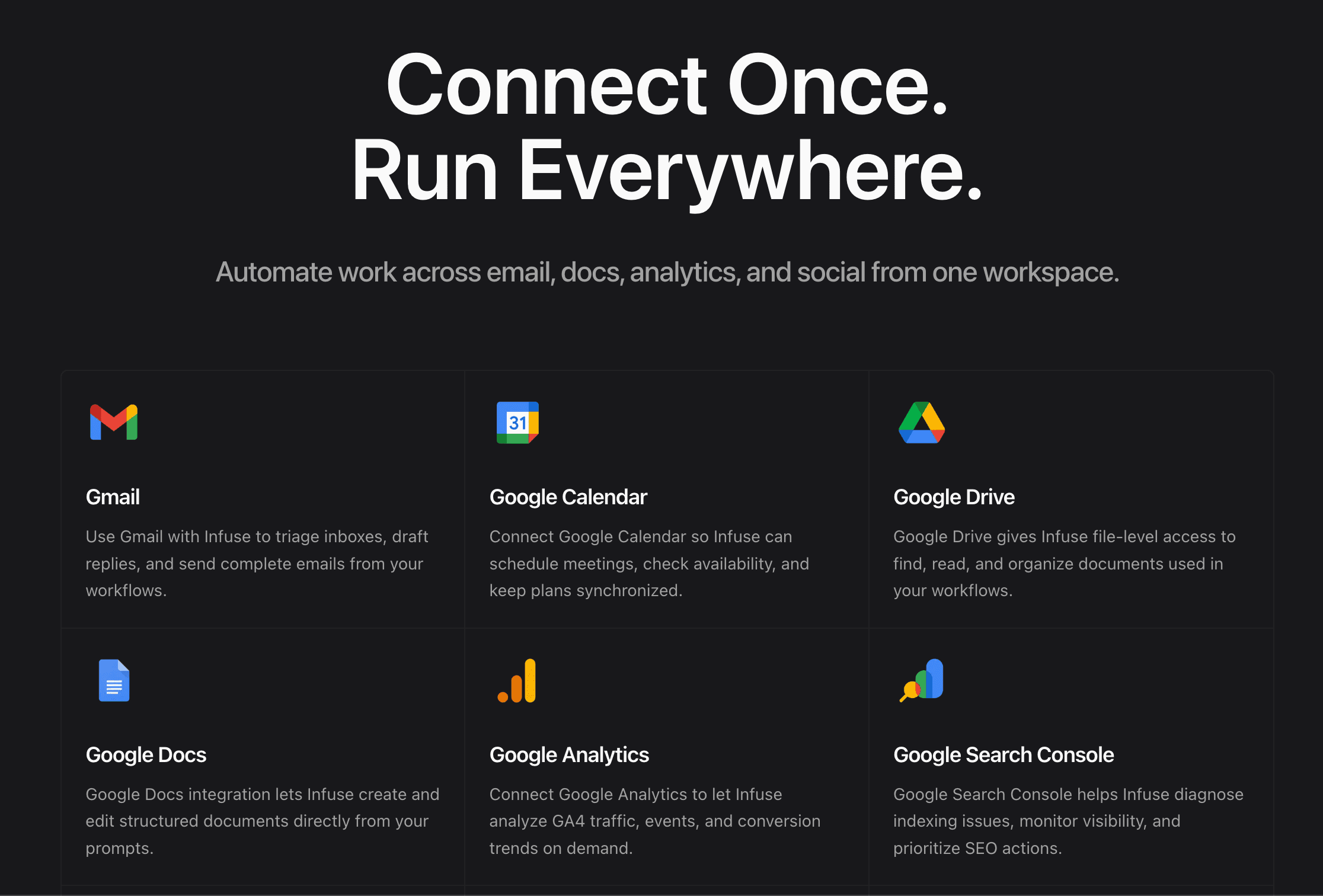
Integration depth matters more than integration count. Many platforms can connect to several business tools. Fewer can make those systems work together in a way that feels seamless to the user.
InfuseOS stands out when the requirement is cross-system execution. Its value is tied to how well it can operate across tools without forcing users to manually bridge the gaps between them. That creates a more connected experience for teams that rely on multiple apps to complete a single process.
This is especially important in real business environments, where work rarely stays inside one system. A sales handoff may involve CRM updates, internal communication, scheduling, document creation and follow-ups. A platform that can span those steps offers more practical value than one that only helps inside part of the workflow.
GenFuse AI offers strong integration capabilities as well, but the experience is typically more workflow-dependent. Its effectiveness often depends on how well the workflow has been configured and how clearly the path has been defined in advance.
So the difference is not simply connectivity. It is how naturally the platform turns that connectivity into action.
Why memory and context matter in ongoing operations
Context is one of the most underestimated factors in enterprise AI. Business work is rarely isolated. It is cumulative. Each task depends on prior conversations, previous actions, system history and organizational preferences.
InfuseOS has an advantage here because it is designed to retain persistent context across tasks. That allows it to support more continuous, business-aware execution over time. The platform is not just responding to a prompt. It is building on what has already happened.
That kind of memory matters for:
- recurring workflows
- long-running projects
- multi-step approvals
- customer or account continuity
- personalized internal operations
GenFuse AI, by comparison, is more likely to operate with session-based or limited context depending on the workflow design and implementation. That can still work well for structured tasks, but it may create friction when the business needs continuity across interactions.
The practical implication is straightforward. The more your operations depend on history, nuance and evolving business context, the more valuable persistent memory becomes.
Which platform is right for you?
Choosing between these platforms depends on what kind of value you want AI to deliver.
Choose GenFuse AI when:
- you want to automate structured tasks quickly
- your team is comfortable designing workflow logic
- your use cases are well-defined and repeatable
- you are primarily looking for assistive productivity gains
Choose InfuseOS when:
- you want AI to work across tools and teams
- your goal is end-to-end execution, not just task support
- your operations rely on context over time
- you need a platform that can translate AI into business outcomes more directly
A useful way to think about it is this: GenFuse AI can help users build and run smarter workflows. InfuseOS is better suited for organizations that want AI to function as an operational layer across the business.
Final verdict
Both platforms can create value, but they do so in different ways.
GenFuse AI is a strong option for teams that want structured automation, productivity support and user-driven workflow execution. It fits organizations that need focused task efficiency and are comfortable working within designed flows.
InfuseOS is the stronger choice for businesses that want an AI business assistant capable of driving execution across systems, retaining context and producing practical operational outcomes. Its advantage is not just that it helps people work faster. It helps the business move work forward more effectively.
If your priority is assistive productivity, GenFuse AI may be the right fit. If your priority is operational impact, InfuseOS offers broader business value.