
InfuseOS vs iBeam: Workflow Automation vs Construction Intelligence
Compare InfuseOS vs iBeam: InfuseOS automates work across business apps, while iBeam specializes in construction plan analysis and estimating.


As AI adoption accelerates, comparing tools by feature list alone is no longer enough. The more useful question is simpler: What kind of work is the product built to do? That distinction matters when evaluating InfuseOS vs iBeam.
At a glance, both products use AI to reduce manual effort. But they belong to different categories. InfuseOS is designed to execute work across the tools teams already use every day. iBeam is built to interpret construction plans and turn them into estimating outputs. One focuses on operational execution across apps. The other focuses on construction intelligence.
For buyers exploring workflow automation solutions, operations software, or a modern AI agent platform, this comparison is less about which product is better overall and more about which one fits the job in front of you.
Two AI Products, Two Very Different Missions
The core difference between InfuseOS and iBeam starts with purpose.
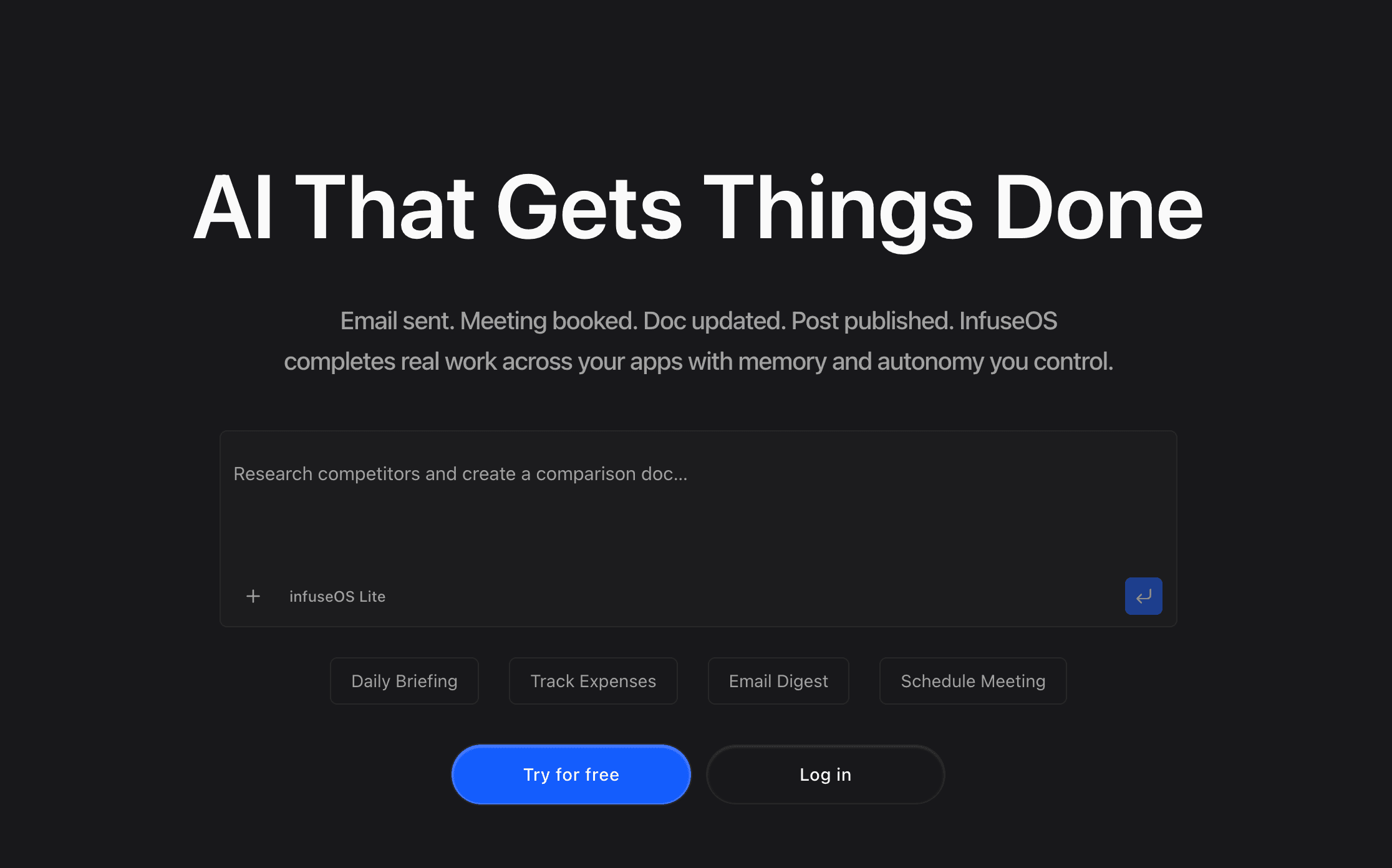
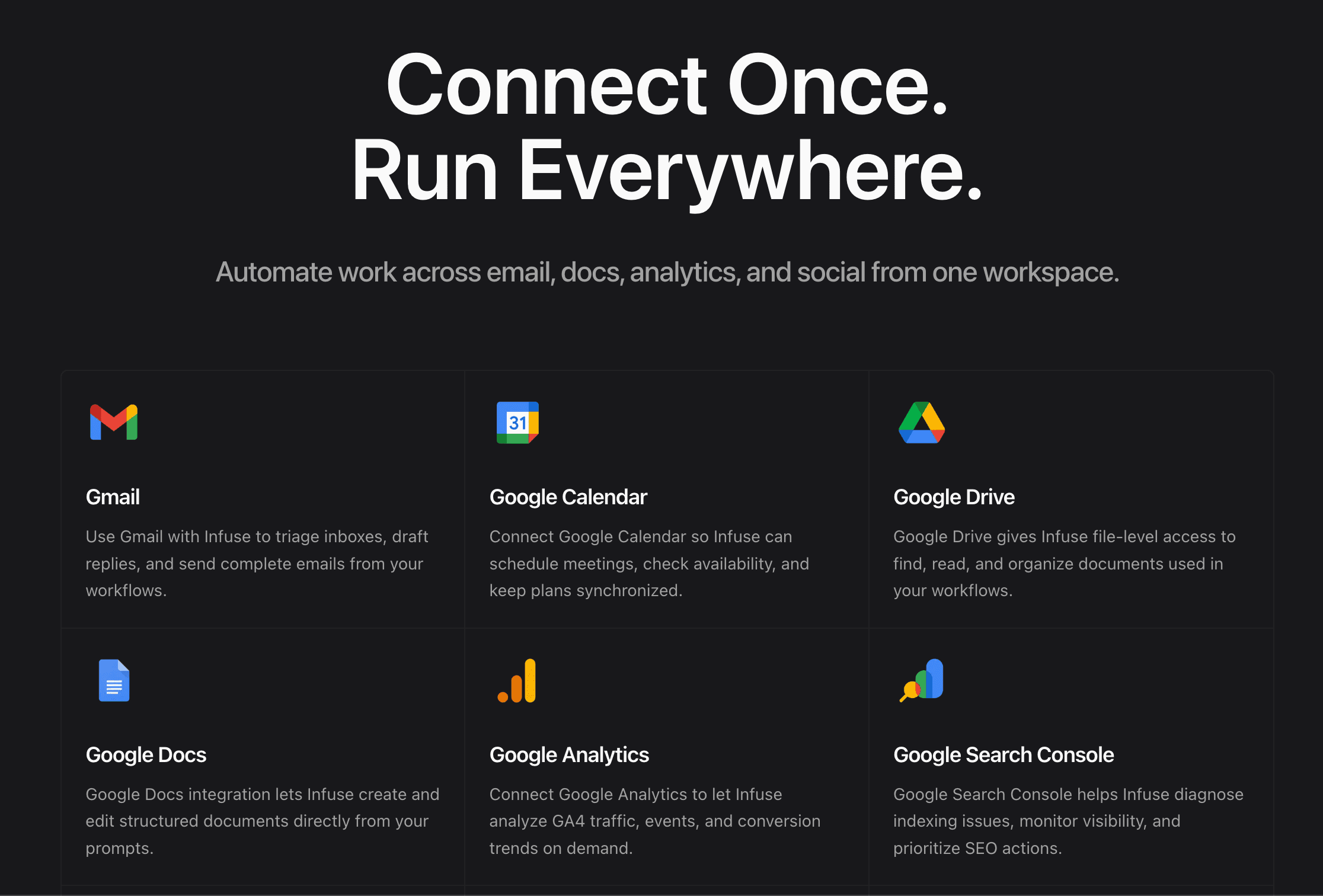
InfuseOS is built around the idea of, “Do my work across apps.” It acts like an AI assistant that can handle recurring tasks, coordinate actions between tools, and support everyday business operations. That can include emails, scheduling, reporting, CRM updates, internal notifications, and repeatable workflows that usually require employees to jump from app to app.
iBeam, by contrast, is designed to analyze construction plans and generate estimates. Its value comes from reading blueprints, extracting materials and quantities, and helping construction teams move faster during bidding and planning. It is specialized AI, built for a specific workflow inside the construction industry.
This makes the comparison especially important because these tools are not solving the same problem. InfuseOS is aimed at operational productivity across functions. iBeam is aimed at construction estimation and plan analysis.
What InfuseOS Brings to Everyday Operations
InfuseOS is best understood as an AI agent platform for business execution. Instead of simply answering questions, it is designed to complete work across software tools.
That means a user can define an outcome such as:
- Every Monday send a report
- Update the CRM after key actions
- Notify Slack when the workflow is complete
- Coordinate scheduling and follow ups
- Handle recurring administrative tasks without manual handoffs
This kind of automation is valuable because much of modern work is fragmented across email, calendars, CRMs, spreadsheets, messaging tools, and internal systems. Teams spend time moving information between platforms, checking status, and following up on repeatable tasks. InfuseOS addresses that problem directly.
Its value grows even more when the system learns preferences over time. Rather than acting like a static rule engine, it functions more like a working assistant that understands how you operate. For companies evaluating workflow automation solutions, that is a meaningful shift. The goal is not just to automate a single trigger. The goal is to reduce the operational drag of daily work.
Why iBeam Excels in Construction Intelligence
iBeam, also known in some contexts as Beam AI, is purpose built for construction workflows. Its strength is not broad business automation. Its strength is structured analysis of plans and drawings.
A typical workflow looks like this:
- Upload PDF plans
- Let the AI read the blueprint
- Extract materials, quantities, and relevant details
- Output an estimate, often in a format such as Excel
That is a very different kind of AI capability. Instead of coordinating software actions across business systems, iBeam focuses on interpreting technical documents and producing estimating outputs. For contractors, estimators, and construction teams, that specialization can create major gains in speed and consistency.
In industries where bid turnaround time matters, and where manual takeoffs consume hours of expert effort, iBeam offers a focused answer to a costly bottleneck. It is not trying to be general operations software. It is trying to make construction estimation faster and more scalable.
The Real Divide: Cross App Automation vs Plan Based Estimation
The clearest way to compare these tools is through workflow style.
With InfuseOS, the workflow is action driven across business apps. A user might say:
- Every Monday send the weekly report
- Update the CRM with the latest status
- Notify the team in Slack
- Schedule follow ups where needed
This is orchestration. The AI is coordinating work across systems and helping the business run more smoothly.
With iBeam, the workflow starts with a construction document. A user might say:
- Upload a set of plans
- Read the blueprint
- Extract quantities
- Generate an estimate
This is document intelligence tied to a specific industry process.
That difference shapes everything from implementation to ROI. InfuseOS helps teams reduce repetitive administrative effort. iBeam helps construction teams accelerate takeoffs, bidding, and project planning. Both save time, but they save time in completely different ways.
AI Capabilities That Define the Buying Decision
If your team is comparing these tools, the AI capabilities should guide the decision more than branding or feature count.
InfuseOS capabilities include:
- Acting like an assistant across apps
- Handling email, scheduling, and reporting
- Running workflows without requiring users to manually build every step
- Adapting to preferences and work patterns over time
- Supporting business process execution across departments
iBeam capabilities include:
- Reading blueprints and construction plans
- Extracting materials and quantities
- Producing cost and estimation outputs
- Supporting construction specific workflows
- Helping teams move faster from plans to bids
In other words, InfuseOS is broad and operational. iBeam is deep and specialized.
That distinction is essential for teams shopping for AI. If you need a system that behaves like an assistant inside your day to day business stack, InfuseOS is the more relevant choice. If you need a tool that can understand drawings and accelerate estimation, iBeam is the better fit.
Setup Required and Time to Value
Setup is another important point of separation.
InfuseOS is appealing for teams that want automation without becoming workflow engineers. Its promise is not just automation, but automation that feels accessible. For many businesses, that lowers the barrier to adopting AI in real operational environments. Instead of stitching together rigid rules, teams can rely on an AI system that helps execute recurring work across tools.
iBeam’s setup is more directly tied to construction inputs and estimating outputs. Users bring plans into the system, and the value comes from how efficiently the platform turns those documents into usable estimates. The path to value is narrower, but also more immediate for the right user.
So while both products can produce fast ROI, they do so in different environments:
- InfuseOS delivers value when teams need ongoing business automation across tools.
- iBeam delivers value when construction teams need faster estimating from plans.
Which Use Cases Fit Best
If your goal is automating business tasks, managing emails, or improving content and internal workflows, InfuseOS is the better fit.
If your goal is construction bidding, estimating, or reading blueprints for quantities and costs, iBeam is the stronger choice.
A practical way to think about it is this:
- Choose InfuseOS for operational execution across software
- Choose iBeam for construction intelligence tied to plans and estimates
That is why this is not a simple head to head between two interchangeable AI products. It is a comparison between two distinct categories of value.
Final Verdict: Choose the AI That Matches the Work
Choose InfuseOS if you want:
- AI to run your daily work across tools
- Automation without building complex workflows yourself
- A more unified operating layer for productivity
- An AI agent platform that supports business execution across apps
Choose iBeam if you want:
- Faster construction estimating
- AI that reads drawings and outputs costs
- Better efficiency in bidding and project planning
- Specialized intelligence for construction workflows
In the end, InfuseOS vs iBeam is really a question of operational scope. If your company needs help managing work across software, communication, and recurring processes, InfuseOS is the stronger solution. If your team needs AI for blueprint analysis and estimating, iBeam is built for that purpose.
The smartest buying decision comes from matching the tool to the workflow. InfuseOS is for businesses that want AI to help run the work. iBeam is for construction teams that want AI to help price the work.